
Most debates about AI power focus on models. The real leverage sits in six other layers.
- The full AI stack has seven layers — Energy, Compute, Data, Models, Orchestration, Agents, and Human-AI Interface — each with distinct chokepoints and different geopolitical stakes.
- Most enterprise AI failures are not model failures. They are data and orchestration failures — problems at layers 3 and 5, not layer 4.
- Whoever controls the connective tissue of AI — the orchestration protocols and interoperability standards — will shape how AI capability is distributed globally.

The Stack, Not the Model
Public debate about AI power almost always resolves to models. Which foundation model is more capable? Which lab has the most parameters? Which country has the most advanced LLM?
This is the wrong frame. A foundation model without the layers below it — energy, compute, data, orchestration — cannot run. A foundation model without the layers above it — agents, human oversight, governance — cannot be trusted with consequential tasks. The battle for AI leadership is not a battle for the best model. It is a battle for the full stack.
The AI stack can be understood as seven distinct layers, each with its own economics, chokepoints, and geopolitical weight. Think of it as the anatomy of digital labor: electricity is the oxygen, compute the muscle, data the bloodstream, models the brain, orchestration the nervous system, agents the hands, and the human-AI interface the conscience.
Seven Layers, Seven Leverage Points
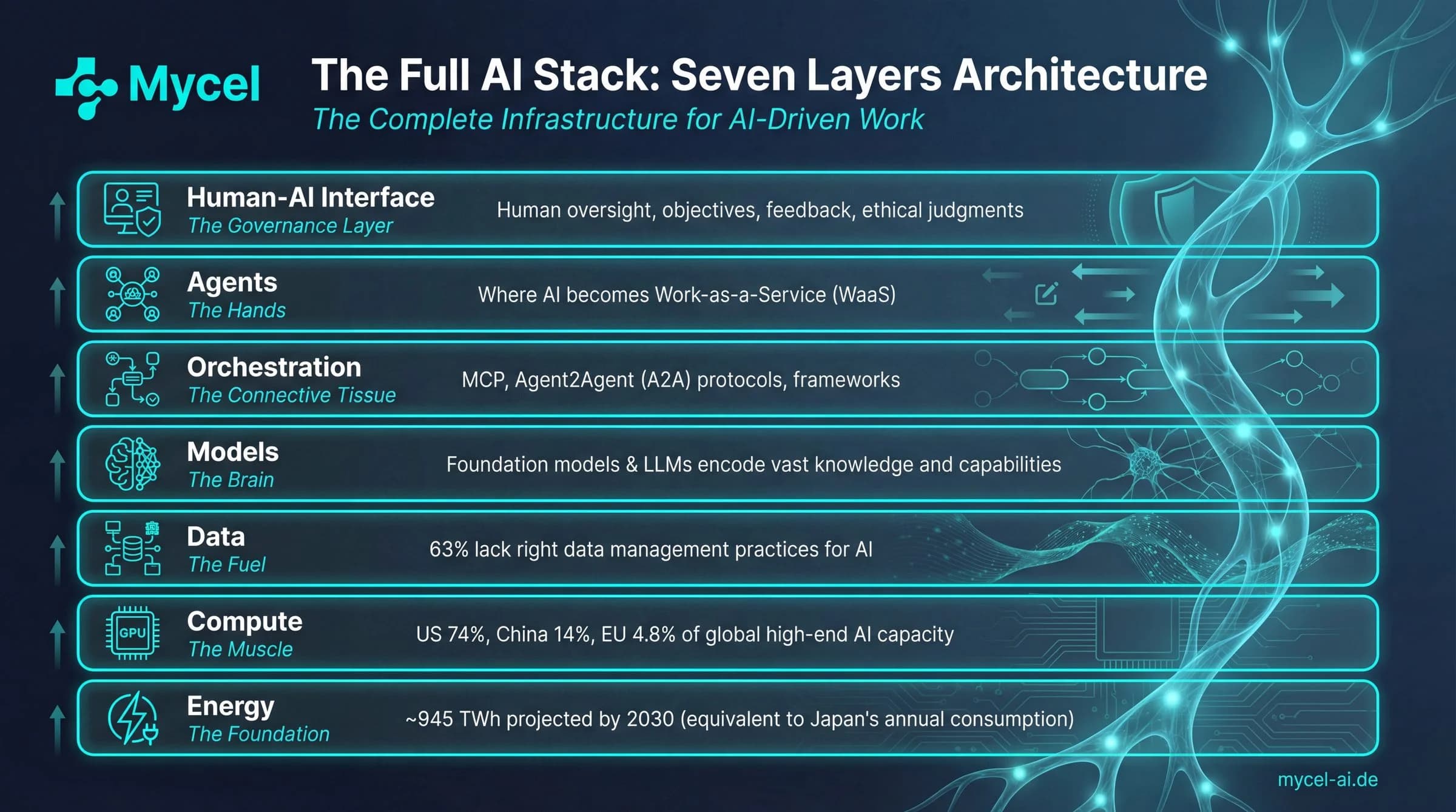
Layer 1: Energy — the Foundation. At the base sits electricity. AI training and inference are power-hungry at a scale that surprises most people encountering the numbers for the first time. Global data center electricity use is projected to more than double to ~945 TWh by 2030, roughly equivalent to Japan's current annual electricity consumption. Without cheap, reliable, and ideally clean power, nothing above this layer functions. Energy is where AI becomes a physical infrastructure problem, not just a software one.
Layer 2: Compute — the Muscle. Next come the chips, servers, and data centers that convert power into processing capability. Global leadership in AI is tightly linked to compute capacity. The United States controls an estimated 74% of global high-end AI compute, while China holds 14% and the EU 4.8%. The semiconductor chokepoint is real: ASML, a Dutch company, is the sole global manufacturer of EUV lithography machines — the equipment without which no advanced chip can be produced. Compute is capability: without enough GPUs and data center capacity, you cannot train frontier models or deliver AI services at population scale.
Layer 3: Data — the Fuel. Data is the layer most often collapsed into "compute" or "models" in high-level discussions, but in real deployments it becomes the decisive bottleneck. Gartner warns that 63% of organizations either do not have, or are unsure they have, the right data management practices for AI, and expects 60% of AI projects to be abandoned without AI-ready data. This layer encompasses training corpora, enterprise data pipelines, vector databases, synthetic data generation, and data quality infrastructure. As a16z noted, in-context learning "effectively reduces an AI problem to a data engineering problem".
Layer 4: Models — the Brain. Foundation models serve as the cognitive engines of the stack. They encode vast knowledge and capabilities. Developing and owning advanced models is a strategic advantage, which is why there is a growing movement toward sovereign and open-source model development beyond the handful of US labs that currently dominate. But models alone are not the product. They are an ingredient.
Layer 5: Orchestration — the Connective Tissue. This is the layer that separates toy demos from production systems. Orchestration includes agent frameworks (LangGraph, CrewAI, AutoGen), workflow persistence engines, API gateways, and critically the emerging interoperability protocols: Model Context Protocol (MCP) for tool connectivity, and Agent2Agent (A2A) for agent-to-agent communication. Nordic APIs calls AI gateways "the missing layer in AI infrastructure" for managing autonomous outbound agent traffic. Orchestration transforms a stateless language model into a stateful, tool-using, goal-pursuing agent.
Layer 6: Agents — the Hands. Applied AI systems that carry out specific tasks or workflows. An AI agent uses one or more models plus tool integrations to achieve a goal autonomously. This is where AI becomes Work-as-a-Service: virtual assistants handling customer support, AI systems managing supply chains, specialized agents assisting knowledge workers. True operational capability emerges when multiple AI components work together in agentic architectures, rather than as isolated models.
Layer 7: Human-AI Interface — the Governance Layer. Even fully autonomous AI agents require human oversight: setting objectives, providing feedback, handling exceptions and ethical judgments. This layer encompasses evaluation frameworks, safety tooling, alignment mechanisms, and the organizational policies that define what agents can or cannot do without human sign-off. It is where the entire stack connects to human society — and where legal liability ultimately lands.
The Three Cross-Cutting Dimensions
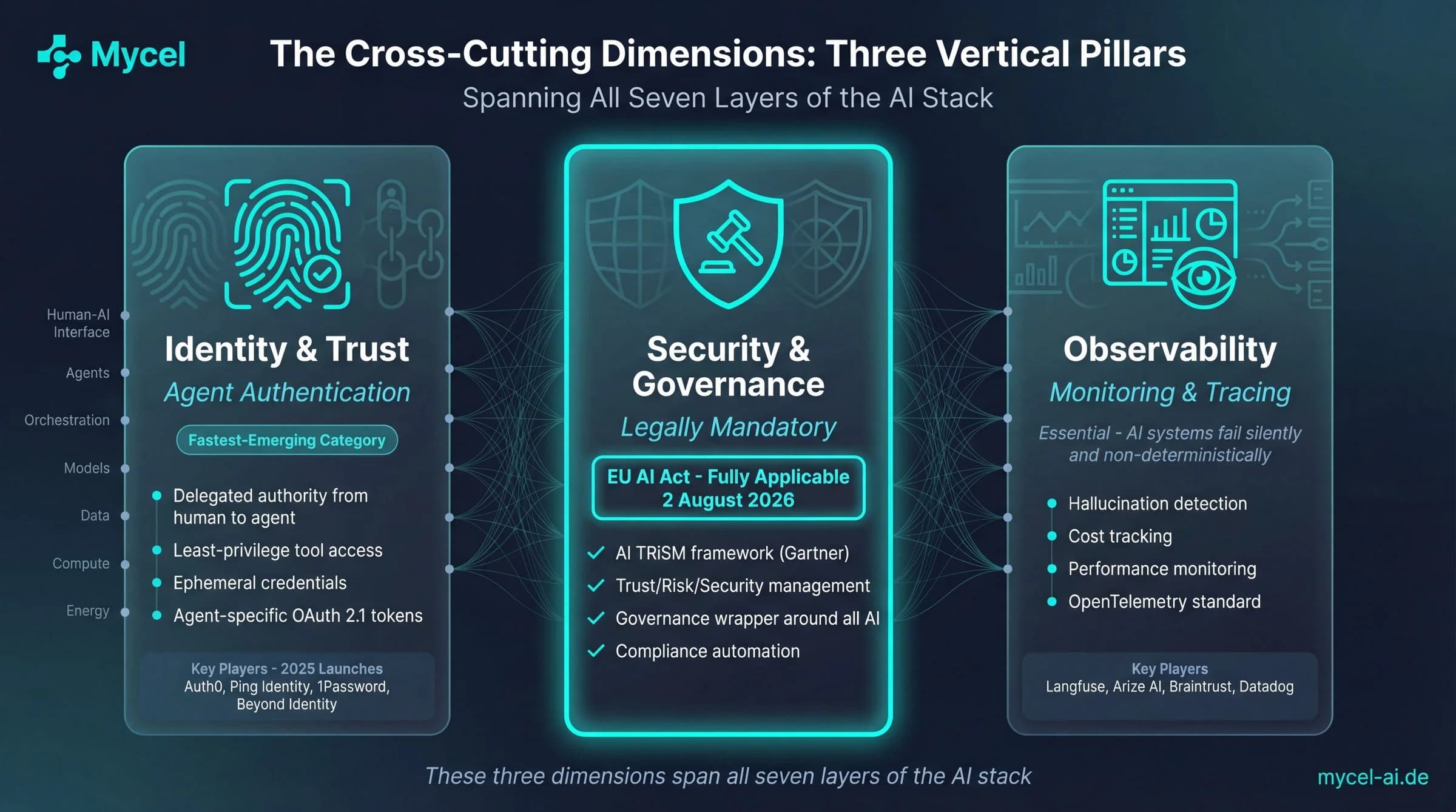
Beyond these seven horizontal layers, three vertical dimensions span the entire stack. They affect every layer, whether organizations plan for them or not.
Identity and Trust is the fastest-emerging new category in AI infrastructure. As agents act autonomously on behalf of humans — browsing the web, calling APIs, modifying files, executing financial transactions — traditional identity management frameworks break down. The emerging concepts include delegated authority, least-privilege tool access, and ephemeral credentials for agent sessions. This is unsolved at scale.
Security and Governance is legally mandatory in the EU under the AI Act, which will be fully applicable on 2 August 2026, with penalties up to €35M or 7% of global annual revenue. Gartner's AI TRiSM (Trust, Risk, and Security Management) framing has become the dominant industry vocabulary for this governance layer. Governance is not a constraint bolted on after the fact — it is an architectural requirement from layer 1.
Observability — covering monitoring, tracing, hallucination detection, and cost tracking — is essential because AI systems fail silently and non-deterministically. OpenTelemetry is emerging as a vendor-neutral standard, with a growing ecosystem of specialized LLM observability tooling built on top of it.
Where AI Projects Actually Fail
With the full stack in view, the pattern of enterprise AI failures becomes legible. The 95% of organizations reporting no measurable P&L impact from generative AI are almost never failing at layer 4. Their models work. Their failures are at layer 3 (data is not AI-ready, pipelines do not exist, enterprise knowledge is trapped in PDFs and legacy systems) and layer 5 (there is no orchestration infrastructure to give agents context, memory, and access to the tools they need to complete real tasks).
The organizations scaling AI successfully have either built or bought capability across all seven layers — not just licensed a foundation model.
Geopolitics as Architecture
The seven-layer model maps directly onto geopolitical leverage. The United States dominates layers 2 through 4 (compute, data, models), and is building quickly at layer 5 (orchestration, with MCP and A2A both originating in US labs). China is building parallel capability across all seven layers, with particular focus on compute independence (in response to export controls) and sovereign models. Europe controls layer 7 — governance, regulation, the standards of trust — through the AI Act and the GDPR. India controls a disproportionate share of the global talent that operates the stack, and is now building upward into layers 1 through 4 with unprecedented urgency.
No single player controls all seven layers. The question for the next decade is which combinations of capabilities — and which partnerships between complementary actors — can assemble a credible end-to-end position.
Anatomy of a Third Force: The AI Stack, Digital Labor, and the India-Europe Corridor traces exactly this question — through the India-Europe corridor, the institutional frameworks already in place, and the opportunity that neither the US nor China has any incentive to build.
This article is part of a series drawn from the Mycel AI white paper "Anatomy of a Third Force: The AI Stack, Digital Labor, and the India-Europe Corridor." The companion articles cover the emergence of Work-as-a-Service, and why the India-Europe corridor may be the most underexploited opportunity in global AI.