Neither the US nor China will build this. That's exactly why it matters.
- India is no longer just an AI talent pool — it is building sovereign foundation models, scaling GPU infrastructure, and deploying clean energy at a pace that few anticipated just two years ago.
- India and Europe are structurally complementary across every layer of the AI stack, in ways that neither US-centric nor China-centric AI strategies accommodate.
- The institutional chassis for a credible third force already exists — EuroHPC JU, the Chips JU, and CETPartnership — but the operating layer that makes cross-border collaboration frictionless is still missing.

India's AI Inflection: Beyond the Talent Story
The standard narrative about India's role in AI runs something like this: world-class engineering talent, strong at IT services, growing startup ecosystem, but dependent on US and Chinese compute, models, and platforms. That narrative is now out of date.
The India AI Impact Summit, held in New Delhi in February 2026, was the moment the old story became inadequate. Over €212B in AI infrastructure pledges were announced, according to IT Minister Ashwini Vaishnaw. 88 nations endorsed the New Delhi Declaration on Trusted, Resilient, and Efficient AI. The European Union, represented by Executive Vice-President Henna Virkkunen, was among the signatories.
But the Summit was a readout, not the cause. The underlying momentum predates it.
Energy and Compute: Real Infrastructure, Real Constraints
India's energy transition is proceeding faster than most projections anticipated. As of 31 December 2025, total installed generation capacity stood at 513.73 GW, with non-fossil sources at 266.79 GW (51.93%). On 29 July 2025, renewables met 51.5% of India's electricity demand for the first time. The constraint is not generation capacity. It is grid reliability: electric power transmission and distribution losses were ~14.16% of output in 2023, which forces data centers requiring five-nines uptime to invest heavily in redundant infrastructure or concentrate in higher-grid metros.
The GPU picture is accelerating toward the constraints. By the February 2026 Summit, the IndiaAI Mission reported over 38,000 high-end GPUs operational, available to startups, researchers, and public institutions at ₹65 per GPU-hour (~€0.61), with a target to cross 100,000 GPUs by end of 2026. Installed data centre capacity stood at ~1.3 GW as of H1 2025. L&T partnered with NVIDIA to build India's largest gigawatt-scale AI factory; TCS announced AI-optimized data centres scaling from 100 MW to 1 GW with OpenAI as anchor customer.
Sovereign Models: No Longer Promises
On 18 February 2026, Sarvam — selected under the IndiaAI Mission to build India's sovereign LLM ecosystem — launched two foundation models. Sarvam-30B is a 30B-parameter mixture-of-experts (MoE) model pre-trained on ~16 trillion tokens across all 22 scheduled Indian languages. Sarvam-105B is a 105B-parameter MoE with a 128K context window. Critically, both were trained from scratch on IndiaAI Mission compute — not fine-tuned on existing open-source systems. Indus, Sarvam's consumer-facing AI chat application, followed two days later — India's first serious indigenous rival to ChatGPT and Claude, handling text and voice across Hindi, Malayalam, Gujarati, English, and more.
The government-backed BharatGen Param2, a 17B-parameter MoE supporting 22 Indian languages with multimodal capability, was also unveiled at the Summit. These are not demos. They are deployed products.
Talent: The Deepest Moat
India's talent position is the most durable advantage in the stack. In the Stanford AI Index (LinkedIn-based metrics), India had the highest relative AI hiring rate year-over-year in 2024, at 33.4%, and a relative AI skill penetration rate of 2.5 — meaning the share of AI-skilled professionals in India's workforce grew 2.5× faster than the global average. The US International Trade Administration estimates India has a pool of ~600,000 AI professionals. Over 4,200 deep-tech startups are now active in India, 84% of them in AI, with AI funding jumping 58% in 2025.
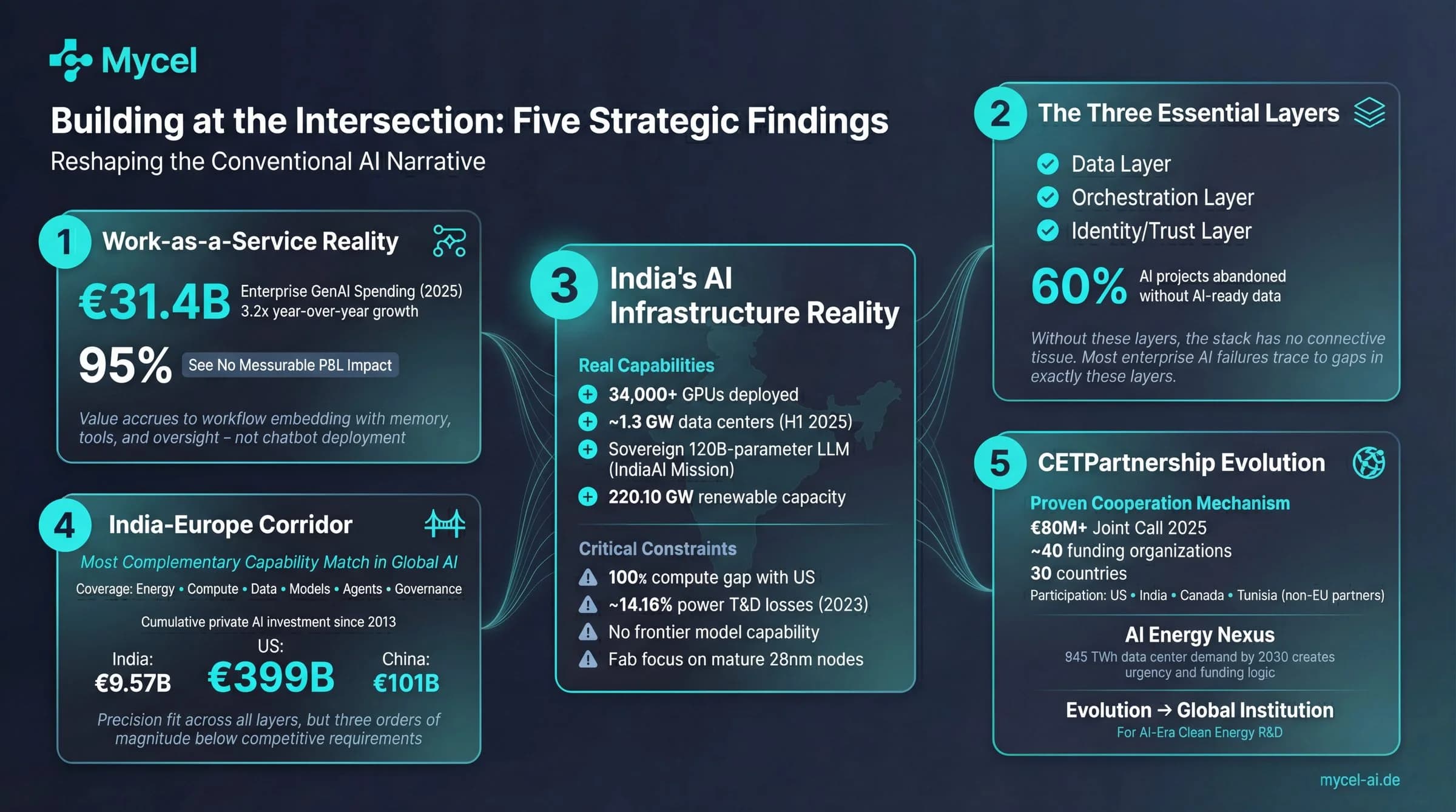
The investment gap remains historically large: cumulative private AI investment since 2013 reached €9.57B for India, compared to €399B for the US and €101B for China. But the trajectory of the past 18 months suggests the gap is no longer structural destiny.
Europe's Complementary Hand
India brings scale, speed, and increasingly its own sovereign AI capability. Europe brings the slower, more durable power of governance, institutions, and chokepoints.
Regulation as strategic asset. The EU AI Act, the world's first comprehensive AI regulation, will be fully applicable on 2 August 2026, with penalties of up to €35M or 7% of global annual revenue. Enforceable provisions have been live since February 2025. Whatever one thinks of its specifics, the Act is becoming a global de facto standard: companies that want access to the EU's 450-million-person market must build to it, and many are applying it globally rather than maintaining parallel governance regimes.
Research funding at scale. Horizon Europe has a budget of €95.5 billion for 2021–2027. Europe's open model work includes EuroLLM, which supports all 24 official EU languages — a direct complement to Sarvam's coverage of all 22 Indian languages.
The semiconductor chokepoint. ASML, based in the Netherlands, is the sole global manufacturer of EUV lithography machines — the technology without which no advanced chip can be produced. The EU Chips Act is directing €43 billion of policy-driven investment through 2030. Europe's position in semiconductor manufacturing is weak; its position in semiconductor technology is a strategic chokepoint.
Talent mobility already underway. Indians are the #1 recipients of EU Blue Cards, with approximately 21,000 in 2023 — 24% of total EU Blue Cards issued. This is not diplomatic aspiration. It is the revealed preference of the talent market.
Three Institutional Vehicles Already on the Road

The surprising finding is that the institutional infrastructure for an India-Europe AI corridor already exists. Three EU partnership vehicles span the most physical layers of the stack, and India has a formal position in each.
EuroHPC JU — the compute bridge. The EuroHPC Joint Undertaking has a budget of ~€7B across 38 participating states, and an explicit legal mandate to develop strategic partnerships with India, Japan, Brazil, and the USA. The GANANA project (February 2025–January 2028), funded at €5M under Horizon Europe, already links seven European countries with five Indian institutions including C-DAC and AIRAWAT. The mandate has since been expanded to include AI Factories.
Chips JU — the hardware pathway. The Chips Joint Undertaking has an expected budget of nearly €11B for semiconductor R&D. India is not yet a participating state, but the EU-India Semiconductor MoU (November 2023) and EU-India Trade and Technology Council commitments on joint R&D in chip design and talent exchange lay the groundwork. The precedent exists: a bilateral cooperation call with South Korea already produced four co-funded projects at ~€12M total.
CETPartnership — the deepest vehicle. The Clean Energy Transition Partnership is the most operationally advanced of the three, because India is already a full participating country — one of only a handful of non-European nations. The CETPartnership Joint Call 2025 has a total budget of over €80M committed by around 40 national/regional funding organisations across 30 countries. India participates through its Department of Science & Technology, with national funding bodies on both sides co-investing directly in joint research.
The EU-India FTA, concluded 27 January 2026, further accelerates the legal and commercial foundation. Bilateral trade is projected to grow from €120B to €200B by 2030 under the agreement.
The Missing Layer — and the Opportunity It Creates
The infrastructure for scaling India-Europe AI cooperation exists institutionally, but lacks the operational platforms to function at scale. The FTA moves goods and people. The TTC creates frameworks. Horizon Europe provides funding. EuroHPC JU, the Chips JU, and CETPartnership coordinate compute, hardware, and energy research respectively.
What is missing is the layer that makes cross-border knowledge work frictionless. The CETPartnership Joint Call 2025 alone spans approximately 40 national and regional funding organisations across 30 countries, each with different submission formats, evaluation criteria, and reporting requirements. A researcher navigating this to find the right consortium partner — and then to manage the collaboration once funded — faces administrative friction that consumes time better spent on the research itself.
This is exactly the kind of workflow that AI agents and orchestration infrastructure can compress. Whoever builds the operating system for cross-border research collaboration — connecting European funding mechanisms with Indian talent, bridging clean energy R&D with AI infrastructure needs, reducing the administrative burden through intelligent agents — will be riding a convergence of trillion-dollar trends with remarkably thin competition.
Neither the US nor China has an incentive to build this. Their AI strategies are fundamentally about consolidation and control. The India-Europe corridor, by contrast, is about distribution and cooperation — an alternative model that, if it scales, could form a credible third force in global AI. Not by outspending the superpowers, but by out-connecting them.
The window is open. Historical precedents — CERN, ITER, Mission Innovation — suggest that the institutions that shape global R&D landscapes are built in windows exactly like this one, when the cost of entry is still tractable and the stakes are not yet fully priced in.
This article is part of a series drawn from the Mycel AI white paper "Anatomy of a Third Force: The AI Stack, Digital Labor, and the India-Europe Corridor." The companion articles cover the emergence of Work-as-a-Service and the seven-layer architecture of the full AI stack.